Pipeline Infrastructure Daily · The Big Drop
How Bad Is It?
The worst threats can't be seen. This is the one you can measure: industrial controllers on the public internet, speaking a protocol with no password, in the geography that moves the country's gas.
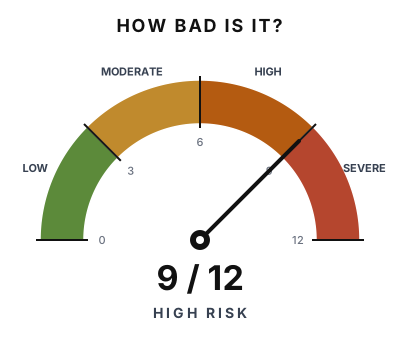
HIGH RISK. Modbus has no authentication by design, so every reachable device is commandable. Real programmable controllers — not just sensors — sit in the exposed set, in oil-and-gas country. Scored on a transparent six-factor rubric (below).
The actual count
A search for port:502 country:US returns 64,468 hits — but about
95% of them (60,978 hits) are not industrial control
devices at all. They are honeypots (467 known decoys running Conpot, software that
impersonates a vulnerable controller), cloud-hosted emulators, and internet scanners — machines that
answer on port 502 with nothing industrial behind them. Strip those out and the confirmed-industrial
set is 3,490.
Focus on authentic field controllers found in the pipeline infrastructure. The controllers, or devices, are connected on utility and telephone carrier networks, not cloud-based services. When this focus is applied, the number narrows to 314. That 314 is the number that matters: programmable controllers actually wired into gas and pipeline operations and reachable from the open internet — the devices where an unauthenticated Modbus command lands on real equipment that can open a valve, change a setpoint or drive a pump, not on a decoy. The filtering is the finding: most of what looks like exposure is bait, and the exposure that can move physical infrastructure is this core.
Where it is
Confirmed-industrial Modbus concentrates where the gas is — Texas, Louisiana, Ohio — once the carrier-centroid states (devices that merely register to a telecom's metro) are read with caution.
tag:ics) by state, 2026-07-17. Shodan geolocation is
registrant-level: a device shows where its IP registers, not where the steel is.| Confirmed device (Schneider Modicon family) | US count |
|---|---|
| BMX P34 2020 | 23 |
| PM5563 | 8 |
| TM241CE24R | 5 |
| 171 CBU 98090 | 4 |
| HMISCUxB5 | 4 |
| Modicon M340 | 3 |
The map
Every confirmed device mapped at its exact Shodan IP-geolocation — public data, not blurred. Brass/red points are field-hosted (utility / telephone carrier networks — the authentic controllers); grey points are cloud-hosted (Linode, Alibaba and the like — almost certainly emulators or decoys). Click a point for its city, network and device model.
Two to Watch
The worst: a controller with no password
The exposed set isn't only sensors reporting a number — it includes programmable logic
controllers: Schneider Modicon M340 (BMX P34), M221 and M241 units that
run the process. Reached over Modbus with no authentication, a PLC will answer a write the
same way it answers its own operator — flip a coil, change a setpoint, command a valve or a pump.
That is the difference between reading a tank level and moving the tank. What it would take to close:
no patch exists for "no password" — the fix is to take the device off the public internet and put it
behind a firewall or VPN.
The one that could rattle the NYMEX: Henry Hub
Henry Hub, in Erath, Louisiana, is the physical settlement point for NYMEX natural-gas futures — the price the whole market quotes. Louisiana carries 212 confirmed-industrial Modbus devices, in the Gulf-Coast corridor whose custody meters and compressor controls run on this same class of gear. The futures settle against physical delivery; a falsified flow or pressure reading, or a forced valve action at a custody point feeding the hub, distorts the signal the market prices against. We do not place any specific device at the hub — Shodan's Louisiana points resolve to carrier metros, not facilities — but the exposure footprint sits squarely in the geography that sets the national price. That is the chaos vector worth watching.
Method & rubric
How the score is built (0–12, disclosed):
| confirmed ics>=100 | +2 |
| unauth protocol(modbus) | +2 |
| controllers present(PLCs) | +2 |
| exposure persists | +1 |
| kev device classes exist | +1 |
| in pipeline geography | +1 |
| Total | 9 / 12 · HIGH |
Every count is a live Shodan query, date-stamped and reproducible. The field-controller figure (~314) is an approximation: it applies the field-vs-cloud share of a product-confirmed sample (9 field / 91 cloud) to the confirmed-ICS total, so treat it as order-of-magnitude. Geolocation is registrant-level. Aggregate only — no operator is named "vulnerable" without per-IP verification and a request for comment.
See it / use the data
Open the live Looker Studio dashboard ↗ Live data Sheet ↗ Shodan: confirmed-ICS 502 ↗ Shodan: raw 502 ↗ Google Earth (KML) ↓ GeoJSON ↓
The Looker button opens a new report pre-wired to a Google
Sheet of the confirmed-ICS-by-state data (sign in, then map state to a US geo chart with
confirmed_ics_502 as the metric). The Sheet is a live source; it currently holds the
2026-07-17 snapshot and is refreshed when the tracker re-publishes it.