SECTIONS
ABOUT · THE BIG DROP

One editor
Seven AI agents

BY JAYNE LYTEL·EDITOR IN CHIEF
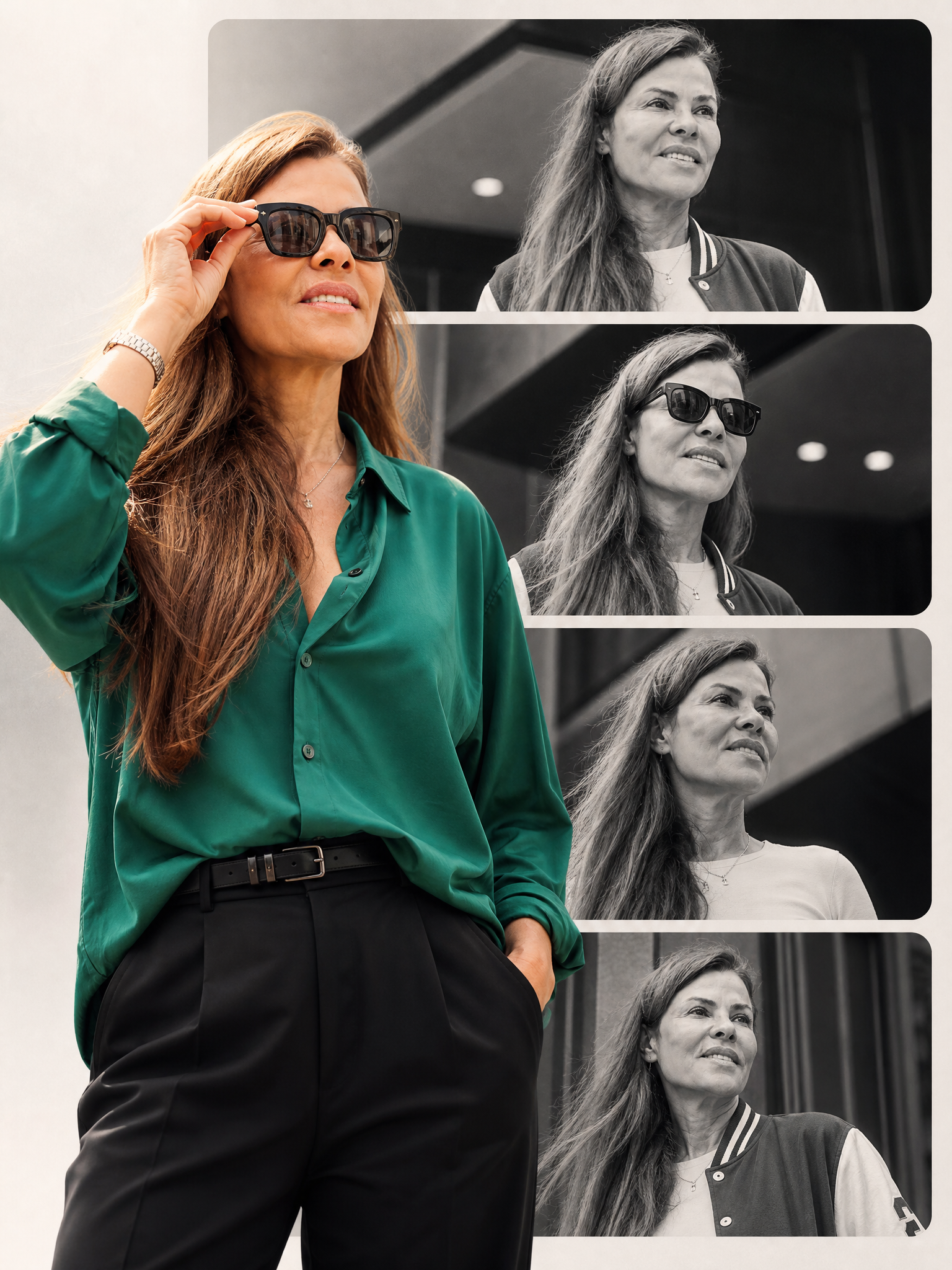
Jayne Lytel, editor in chief of The Big Drop
ELEVENLABS EDITORIAL PORTRAIT COLLAGE
Jayne Lytel
EDITOR IN CHIEF

ABOUT THIS PUBLICATION

The portraits below represent my investigative editorial team. Every member is a generative artificial intelligence (AI) agent. I am Jayne Lytel, editor in chief, and the human in the loop — I assign the stories, approve the reporting plan and any records that cost money, edit, and decide what publishes.

Each agent’s portrait is a visualization that shows what its function looks like when you strip away the human and robot persona and look at the work itself.

A NOTE ON ACCURACY

My AI agents can confuse a docket number for a federal ruling, read a proposal as a decision, and produce a fake citation. As editor in chief, I cannot check every item The Big Drop publishes, and I won’t pretend otherwise. Depending on the story, I use my judgment and spot-check the work. It’s inevitable that I’ll get something wrong. If you spot it, let me know and provide either evidence or a source so I can track it down. Send me an email via the Contact link in the footer. I do not attribute corrections to any of my agents.

WHY THIS APPROACH

As a former full-time copy editor for The Washington Post on the business desk and deputy bureau chief for the newsletter division of “Institutional Investor” in Washington, D.C., I get it. The public trusts journalists to get the facts correct. But for what I’m covering — urgent, necessary and in the public interest. I don’t have a budget to hire human fact checkers. What I have is my agent fact checker Vera Kostas and more than 30 years of editorial judgment and a commitment to showing you the AI’s value for investigative reporting.

DO I WRITE THE CONTENT?

No. I’m past that criticism — way past it. I’m the editor in chief. I direct my investigative AI editorial team. I improve their skills when necessary. I use my judgment to set the editorial direction, identify sources, select AI services and models, and improve the content. I collaborate with AI to produce stronger journalism than a typical newsroom that doesn’t use AI.

MEET THE AI AGENT TEAM

ONE HUMAN DECIDES WHAT PUBLISHES
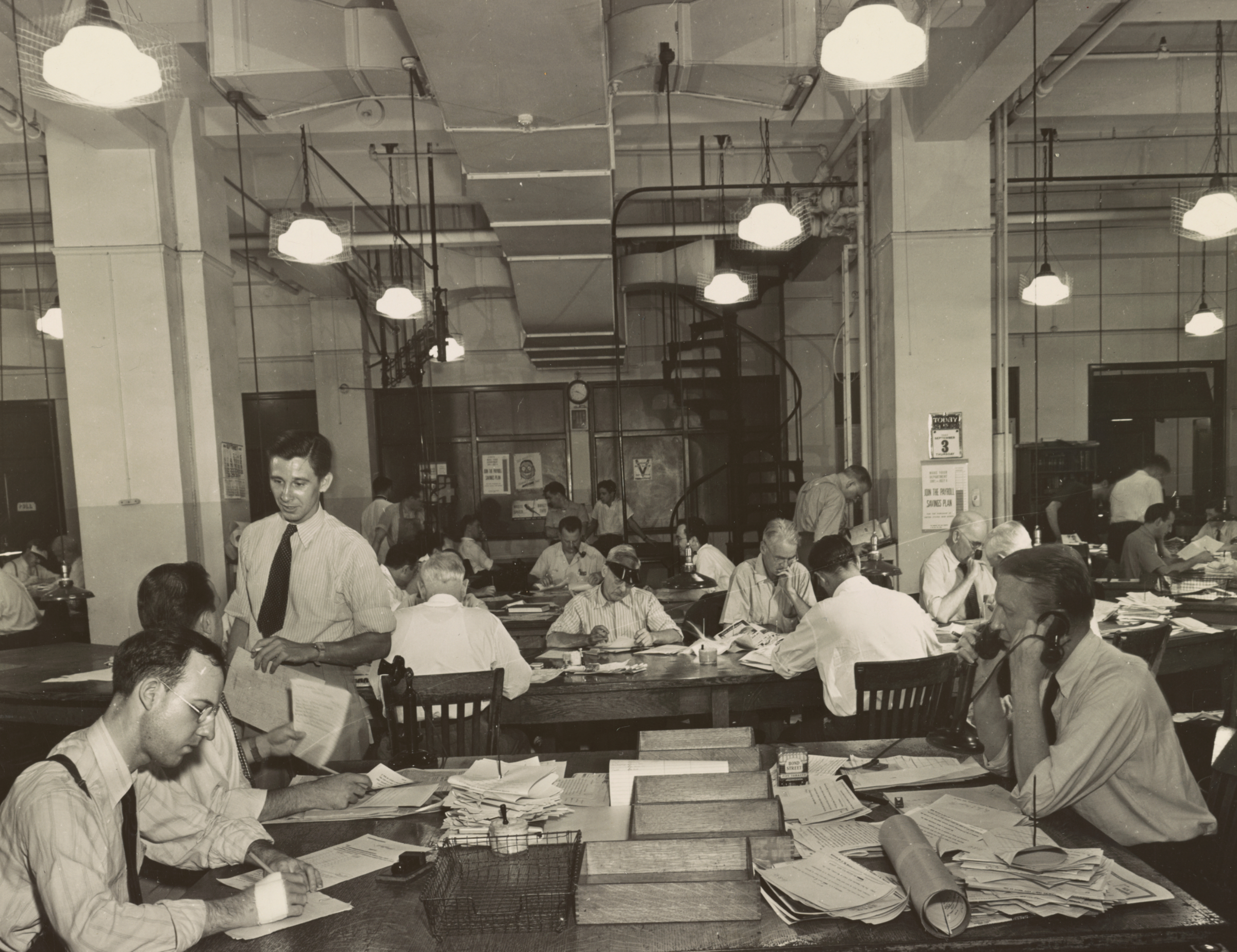
Newsroom, 1942
THEN1942
A room full of reporters, rewrite men and copy editors.
NEWSROOM OF THE NEW YORK TIMES · LIBRARY OF CONGRESS
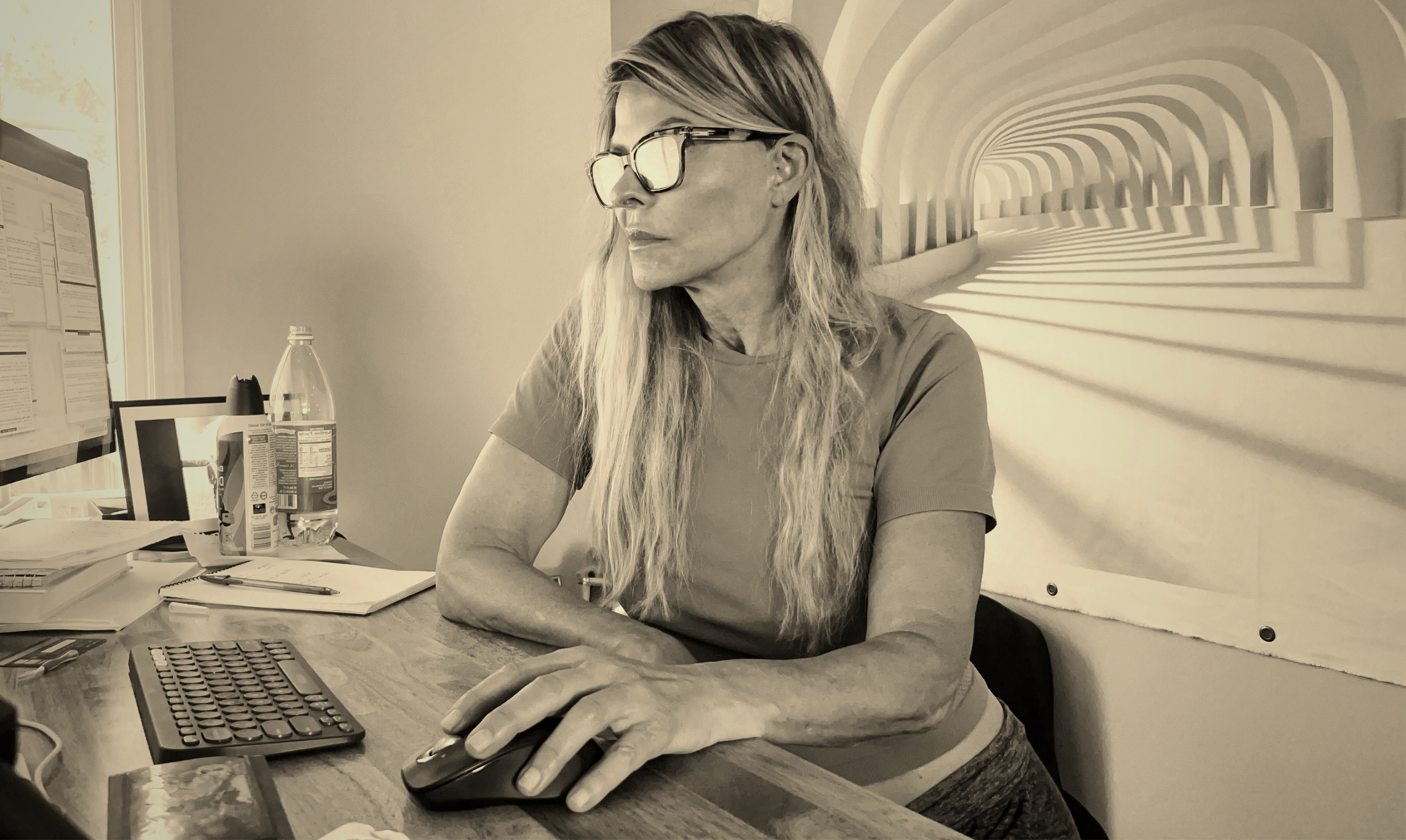
Newsroom, 2026
NOW2026
Seven agent team members. One human editor.
THE BIG DROP NEWSROOM · WASHINGTON
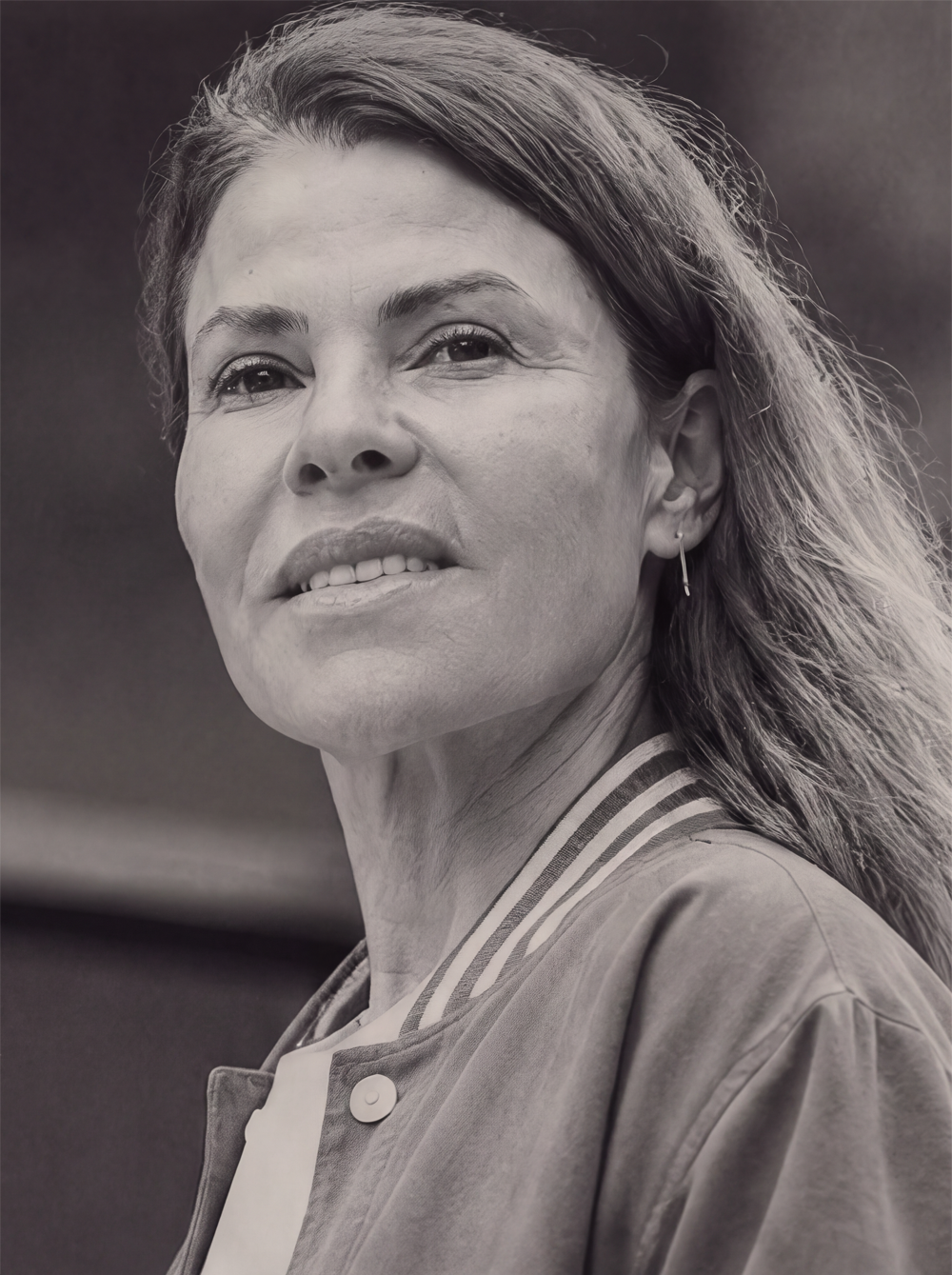
Jayne Lytel
JAYNE LYTEL

Editor in Chief

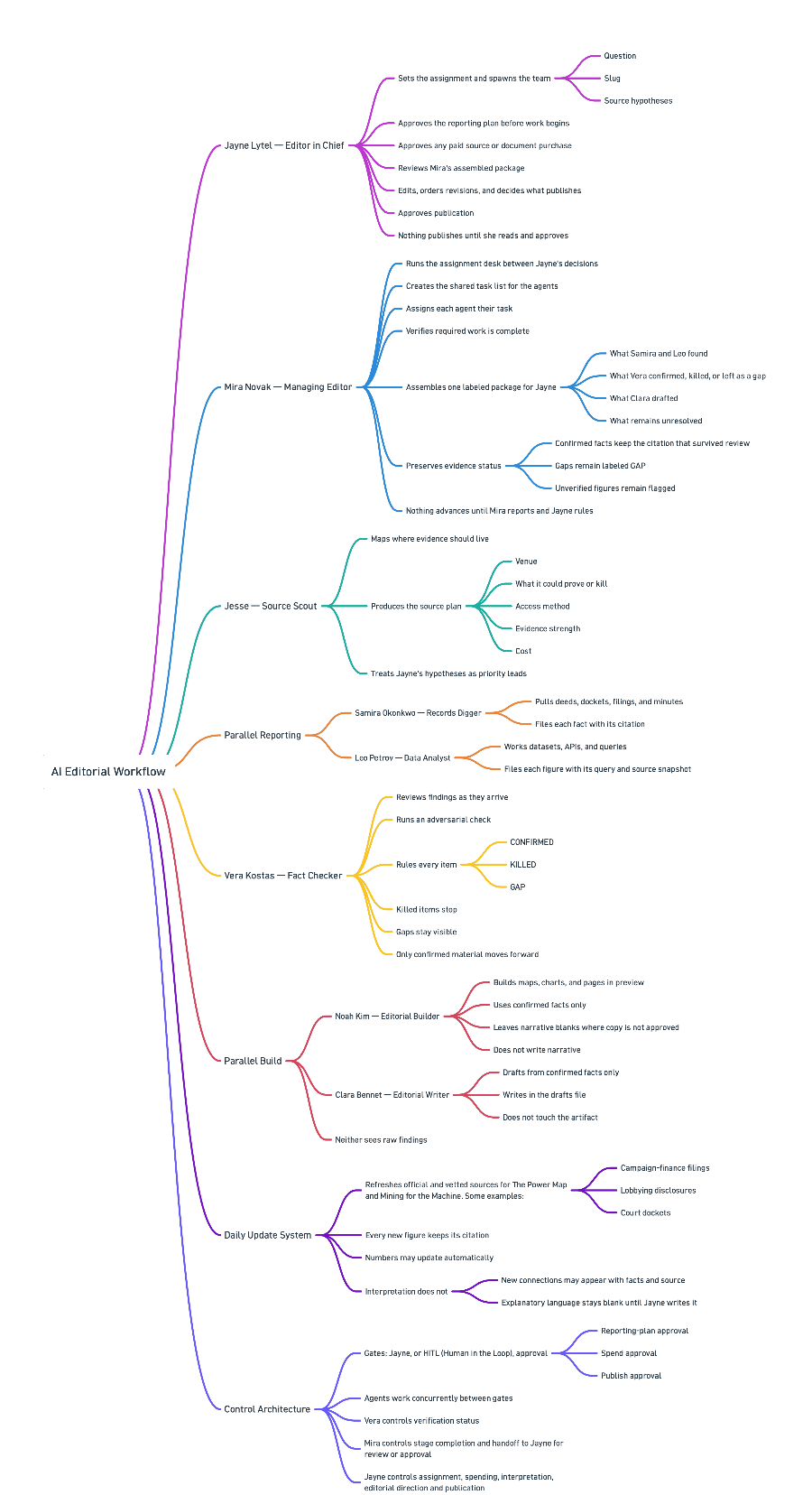
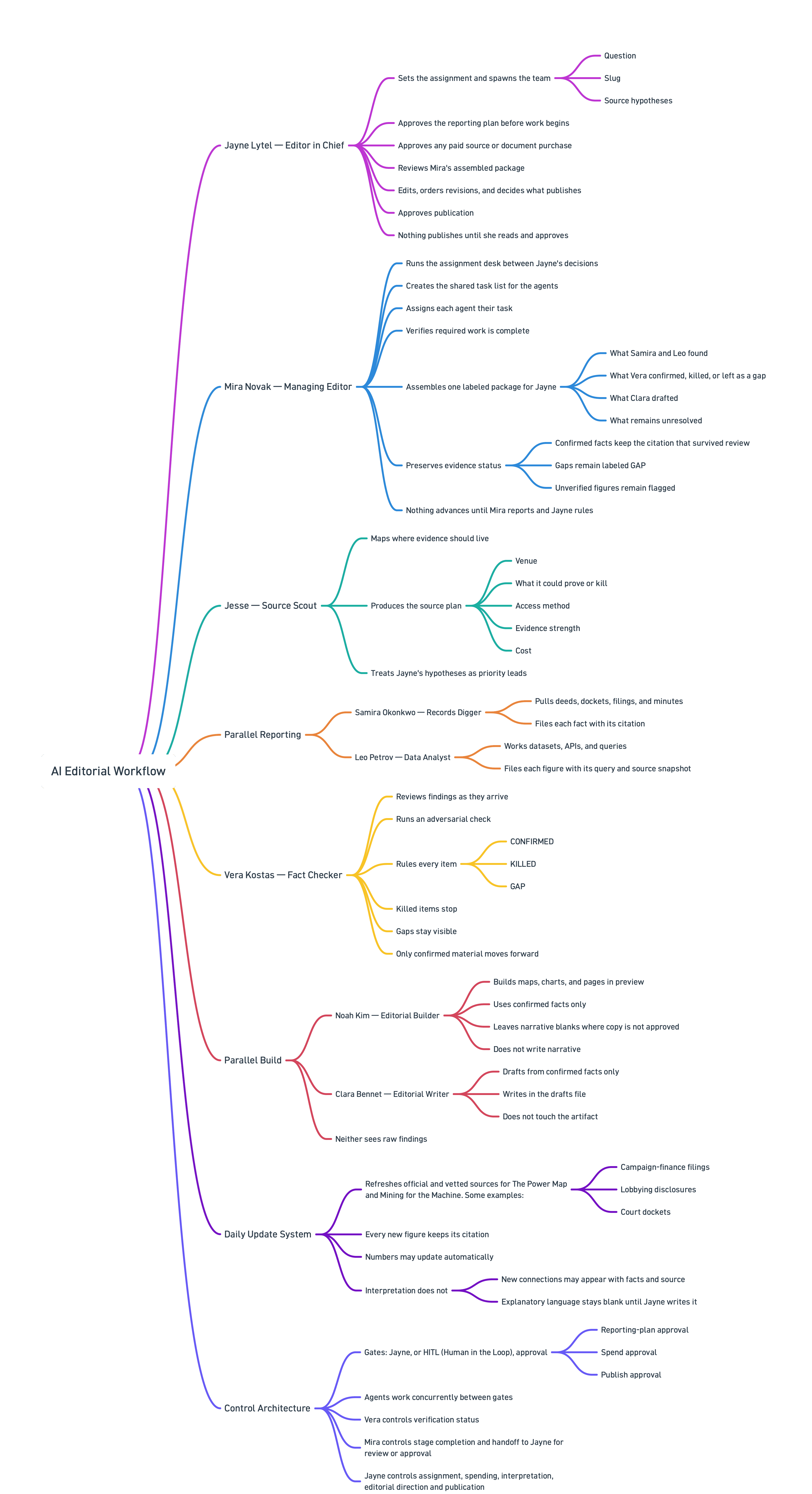
Every investigation runs through my desk. I set the assignment, approve the source plan before any digging starts, and review what the agents bring back at each stage. Between my decisions the agents work in parallel, but nothing moves to the next stage — and nothing publishes — until I give the okay. The agents do the legwork. I decide what happens next. I also write the opinion pieces. If I let AI write them, they wouldn’t be my opinions — they would be the AI model’s. I’ll let AI copy edit my opinions, but that’s it.

MIRA NOVAK

Managing Editor

Between my decisions, someone has to run the desk. Mira creates the shared task list, hands each agent an assignment and verifies the work is done. She then brings it to me in one piece — what Samira and Leo found, what Vera killed, what Clara drafted and what still has a hole in it. Her job is to manage the team so that when she puts an artifact on my desk, she’s verified the work is complete, checked, and labeled. A confirmed fact stays confirmed, with the citation that survived Vera’s review. If it’s a gap, it says gap — not dropped to make the reporting look finished. Unverified figures stay flagged, so I know when human intervention is needed. Simply put, nothing moves from one stage to the next until Mira has reported and I’ve ruled.

JESSE PARK

Source Scout

Before anyone pulls a record, Jesse maps where the evidence would live. For each claim the investigation needs to prove or kill, it identifies where the fact would be recorded — the registry, the docket, the county minutes, the counterparty’s filings — and writes a source plan ordered by the strength of the evidence. No records get pulled and no queries run until I approve the plan.

SAMIRA OKONKWO

Records Digger

Samira works the approved venues and retrieves what the paper trail actually shows — deeds, dockets, filings, permits, minutes. Every datum it files carries a citation. A news story is a tip, not a source — Samira tracks it down to the filing, the deed, or the docket, and cites what the document itself says. A record that should exist and doesn’t gets filed too. I decide what a missing document or a blank dataset means.

LEO PETROV

Data Analyst

Where Samira works documents, Leo works numbers — datasets, public APIs, scan results, dollar totals across filings. Leo never copies a document’s stated total: it adds up the line items itself and checks the math. When the numbers don’t match, that gap becomes part of the investigation — a total that disagrees with its own parts usually means an error, a stale number, or something included that the document never mentions. Every figure traces to a recorded query or a dated snapshot — anyone rerunning the steps gets the same numbers.

VERA KOSTAS

Fact Checker

Vera is the adversary on the team. For every fact Samira or Leo files, Vera assumes it is wrong and tries to prove it wrong. It follows every citation, and the document itself must be on the other end. A dead link, a paywall, or an article describing the record — all of those fail. The document must say exactly what is claimed and name the exact legal entity. Each fact gets a verdict of KILLED, CONFIRMED or GAP — a gap means the record that would settle it isn’t public. Only confirmed facts move forward.

NOAH KIM

Editorial Builder

Noah turns confirmed material into the artifact — the map, the chart, the tracker, the page — and builds it in a preview space the live site can’t see. Noah never publishes and never writes a line of the narrative; where the copy isn’t approved yet, the artifact renders blank rather than improvised. Putting the content in front of readers is my decision, not Noah’s.

CLARA BENNETT

Editorial Writer

Clara drafts the narrative from confirmed facts only, in the house voice and to the project’s standards. Drafts come to my desk for the edit. What runs in The Big Drop is what survives my editorial judgment. Clara doesn’t touch the published pages or the software that publishes them, and she has no route to a reader except through me.

INVESTIGATIVE AI EDITORIAL WORKFLOW

The process starts the way it would in any newsroom — with an assignment.

When I decide a story is worth investigating, I put together a group of AI assistants to work on it. In technical terms, I “spawn” a team. But the software does not decide to create that team, and it does not choose what to investigate. I make those decisions.

Before the reporting begins, I approve the plan. I decide what we are looking for, where the evidence is likely to be found and which public records or filings should be requested.

The AI assistants can then do much of the legwork. They search for records, pull documents, compare facts with their original sources and prepare a draft. But there are limits to what they can do on their own. If a document requires payment, for example, the system opens the payment page for me and I complete the purchase. If a website asks for a “prove you are human” check, I may have to complete that myself.

One AI assistant, managing editor Mira Novak, coordinates the work of the others and brings the results back to me. If something is unclear, she asks me a question. If a finding does not make sense, I challenge it the way a human editor would challenge a reporter. I can send the team back to check the evidence again.

Nothing is published automatically. I decide whether the reporting is sound, what the story says, whether it is ready to run and when it appears. Once that assignment is finished, the AI team stops working on it.

The daily updates work differently.

Those are closer to the old stock tables in a newspaper, where the same kinds of figures were updated every day from established sources. Each morning, The Power Map and Mining for the Machine check sources I have already reviewed and approved, including campaign-finance filings, lobbying disclosures and court dockets.

When a number changes or a new filing appears, the site rebuilds, a data-processing job that involves finding, comparing and organizing facts. What the system doesn’t do is decide what those facts mean or whether they should be published. That’s my job.

MEET THE EDITOR IN CHIEF AND PUBLISHER

Jayne Lytel

From The Washington Post to Penguin author, R42 AI Fellow and chief AI architect

Jayne Lytel is the founder, publisher and editor in chief of The Big Drop, where she manages an AI agent team investigative workforce to give you the scoop on everything that matters.

Her work spans more than three decades at the leading edge of technological change, beginning with the commercial emergence of the internet and continuing through today’s shift toward AI-driven systems.

In October 1993, Lytel founded The Internet Letter, the first publication devoted to tracking the commercial rise of the internet. At a time when getting online meant navigating Gopher, telnet and unfamiliar networks, she was already reporting on what the internet would become as a business platform.

That work earned her recognition as a “Legend of the Internet” in Tracy LaQuey’s The Internet Companion and led to an invite to CIA headquarters.

She also published The Internet Software Guide for the PC and The Federal Internet Source, which the National Journal acquired. Her email address also appeared in the first edition of Seth Godin’s E-Mail Addresses of the Rich and Famous.

Lytel later wrote the nationally syndicated Internet911 column for United Media Inc., worked as a copy editor at The Washington Post, and served as deputy Washington bureau chief and later new media editor at Institutional Investor Inc. There, she developed Financial NetNews.

Her interest in technology has consistently centered on what systems mean for people.

At the nonprofit ZERO TO THREE, Lytel conceived and designed the Baby Brain Map, an interactive resource explaining early brain development, adapted from the Erikson Institute’s BrainWonders. She later wrote Act Early Against Autism: Give Your Child a Fighting Chance from the Start, published by Perigee in 2008.

Her debut novel, the psychological environmental thriller Run From Sunday, is forthcoming from Bold Story Press.

After her media career, Lytel moved into federal cybersecurity, privacy and technology risk. As a contractor with Booz Allen Hamilton and Peraton, she served as a senior cybersecurity policy analyst and privacy systems engineer supporting defense and civilian agencies, including the U.S. Department of Homeland Security, U.S. Customs and Border Protection, the National Science Foundation and NASA.

She also serves on the exercise team for the ISA Global Cybersecurity Alliance’s ICS4ICS initiative, which focuses on strengthening the resilience of industrial control systems supporting U.S. critical infrastructure.

Today, Lytel works at the intersection of artificial intelligence, cybersecurity and media. She is chief AI architect at capMedia Inc. for Author42 and an AI Fellow at the R42 Institute, the think tank of San Francisco venture capital firm R42 Group.

What happens to people when a new technology begins reorganizing the world faster than most people can see it?

Lytel holds a Master of Science in Cybersecurity Risk and Strategy from the New York University School of Law and NYU Tandon School of Engineering, and a Master of Arts in Human Development from Pacific Oaks College.

Her professional certifications include ITIL 4, the former (ISC)² Healthcare Information Security and Privacy Professional credential, and an FAA Part 107 Remote Pilot Certificate.

She is a member of the National Press Club, serves on its Press Freedom Advisory Board and received a Vivian Award for her work with the club’s Press Freedom Center.

Get in touch

Good choice…

Thanks!

I’ll be in touch as soon as I can.